Structural renovation projects demand precise subsurface information to avoid catastrophic failures during construction activities. Ground-penetrating radar delivers non-destructive imaging that reveals hidden utilities, reinforcement, and structural elements before cutting or coring begins. This technology has evolved from specialized geophysical equipment into standard construction safety protocol, particularly in dense urban environments where aging infrastructure creates substantial risk. The ability to map subsurface conditions accurately prevents worker injuries, service disruptions, and costly project delays.
Key Takeaways
- GPR uses electromagnetic pulses to detect subsurface features, including rebar, utilities, and post-tension cables, without invasive methods
- Utility strikes cost $25,000 to $100,000 per incident, making GPR scanning a critical risk management investment
- Los Angeles structural renovation projects show 72% GPR adoption due to seismic requirements and dense underground infrastructure
- Contractors must evaluate project frequency to determine whether purchasing, renting, or hiring GPR services delivers optimal value
- ROI from utility detection averages $21 for every dollar spent through strike prevention and liability reduction
What Is Ground Penetrating Radar and How Does It Work in Construction?
Ground-penetrating radar uses electromagnetic pulses to create detailed images of subsurface features in concrete and soil. The system transmits radio waves that reflect off buried objects, generating data visualizations called radargrams that trained technicians interpret to identify utilities, rebar, voids, and other hidden elements. Multi-frequency antennas allow contractors to adjust penetration depth and resolution based on specific project requirements. High-frequency antennas operating between 1.0 and 2.6 GHz provide detailed concrete imaging, while lower frequencies from 100 to 500 MHz penetrate deeper for utility detection up to 15 feet.
Key Components and Technology Features of GPR Systems
Modern GPR equipment integrates multiple antenna frequencies to address different scanning applications within a single project. Handheld concrete scanners like the GSSI StructureScan and Proceq models use high-frequency antennas for precise rebar and conduit mapping in slabs and walls. Cart-based utility systems deploy lower frequencies to map underground pipes and cables before excavation activities. Vehicle-mounted systems serve large-scale infrastructure analysis, while very low-frequency antennas between 10 and 100 MHz remain limited to specialized environmental applications requiring deeper geological interpretation.
Types of GPR Equipment Used in Structural Renovations
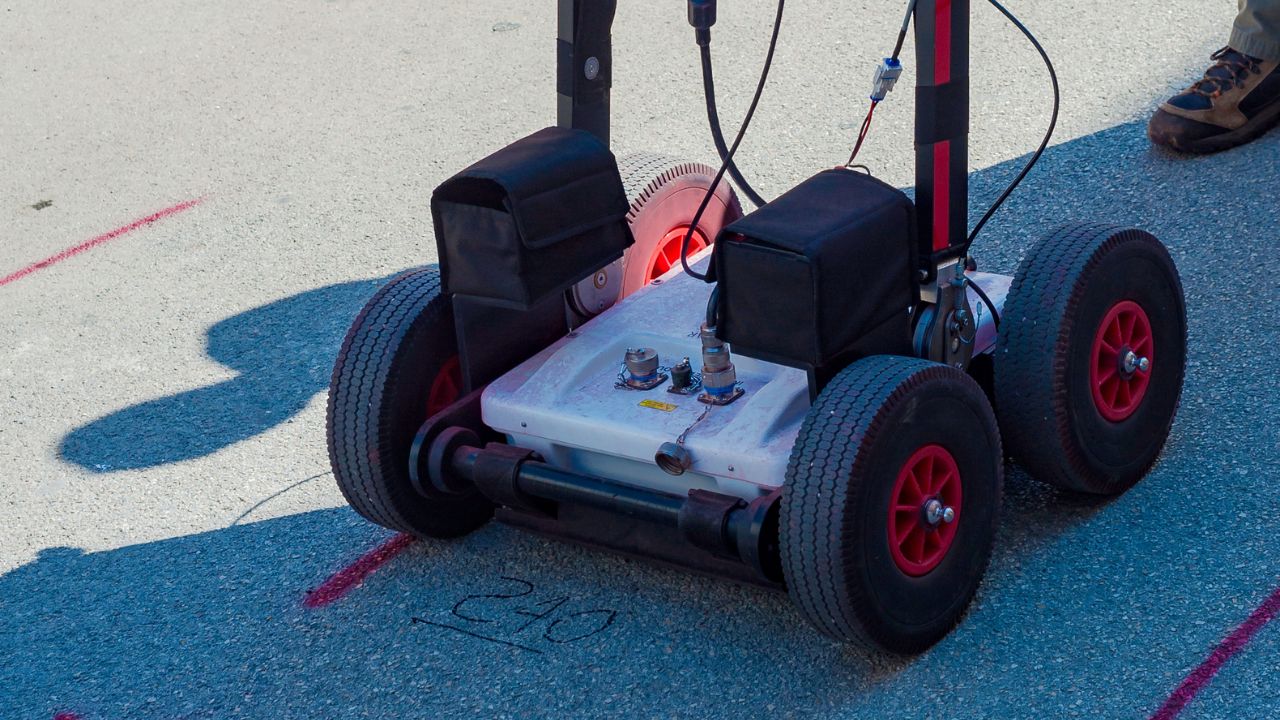
Contractors select GPR equipment based on project scale, target depth, and required resolution for accurate subsurface mapping. Handheld concrete scanners provide portable solutions for structural assessment and post-tension cable location during tenant improvements. Cart-based systems offer mobility for comprehensive utility detection across larger sites. Vehicle-mounted platforms enable rapid data collection for roadway and parking structure evaluation, where speed and coverage area justify the higher equipment investment.
Differences Between GPR Applications for Concrete and Utility Detection
Concrete inspection requires high-frequency antennas that sacrifice penetration depth for superior resolution when locating rebar grids and embedded conduits. Utility detection applications employ lower frequencies that penetrate soil more effectively but produce less detailed imagery of individual objects. The concrete investigation segment demonstrates 9.2% compound annual growth as renovation activity increases and building codes mandate non-destructive verification before core drilling. Utility detection maintains 28% market share due to the 192,000 annual utility damages that drive demand for prevention technology.
Why Is GPR Scanning Critical for Structural Renovation Projects?
Structural renovation GPR scanning prevents catastrophic failures that result from blind cutting, coring, and excavation in existing buildings. Damaged post-tension cables can cause immediate structural collapse, while severing live electrical conduits creates fatal electrocution hazards for workers and building occupants. Utility strikes generate direct costs between $25,000 and $100,000 per incident through emergency repairs, regulatory fines, and project delays. Los Angeles building code compliance requires a comprehensive subsurface investigation before invasive work begins, particularly in seismically vulnerable structures where structural integrity cannot be compromised.
Safety Benefits and Risk Mitigation in Renovations
Fatal accidents from undetected utilities and structural elements create severe liability exposure for contractors and property owners throughout renovation projects. Ground-penetrating radar for construction projects eliminates blind work by revealing the exact locations of hazards before cutting equipment contacts critical infrastructure. Project delays from utility damage frequently exceed the initial strike cost through cascading schedule impacts and contractual penalties. Insurance carriers increasingly require documented GPR scanning as a condition of coverage for high-risk renovation work.
Compliance With Building Codes and Seismic Requirements
Seismic structural integrity requirements in the Los Angeles market create heightened liability for contractors who compromise load-bearing elements during renovation activities. Building departments mandate comprehensive documentation of subsurface conditions before issuing permits for invasive work in seismic zones. Non-destructive testing verification protects contractors from claims of negligent construction practices that violate established safety standards. Regulatory enforcement has intensified following several high-profile structural failures linked to inadequate pre-construction investigation.
Supporting Non-Destructive Testing and Assessment
Ground-penetrating radar serves as the primary geophysical tool for construction non-destructive testing that preserves structural integrity during investigation. Concrete scanning capabilities reveal rebar spacing, slab thickness, and embedded conduits without destructive coring or probing that weakens structural members. Pre-demolition assessment identifies post-tension cables and hazardous materials that require specialized handling procedures before selective demolition begins. This non-invasive approach reduces investigation costs while delivering superior subsurface information compared to destructive sampling methods.
Who Are the Main Users of GPR in Structural Renovations and What Are Their Preferences?
Mid-career construction professionals aged 45-54 demonstrate the highest GPR adoption rate at 72%, followed closely by contractors aged 35-44 at 68%. Urban centers achieve 76% adoption compared to 62% in suburban areas and only 38% in rural regions, where infrastructure density remains lower. West Coast regional adoption leads nationally at 78%, driven by seismic requirements and high property values that justify technology investments. Construction professionals prioritize accuracy, safety features, and cost-effectiveness when evaluating GPR solutions for renovation workflows.
Adoption Trends Across Career Stages and Geographic Regions
Ground-penetrating radar renovation LA market analysis shows 72% adoption for structural renovation projects and 68% for demolition applications. High-rise construction adoption reaches 65% as downtown Los Angeles buildings require extensive post-tension cable mapping before tenant improvements begin. Dense urban utility infrastructure creates complexity that drives adoption rates significantly higher than suburban or rural markets. Geographic concentration of adoption reflects both regulatory stringency and the financial consequences of utility strikes in high-value metropolitan areas.
Priorities When Selecting GPR Solutions for Renovation Projects
Construction professionals evaluate equipment based on demonstrated accuracy rates, depth capabilities, and proven performance with similar project types and scales. Contractors seek comprehensive service integration that combines utility locating and renovation in Los Angeles capabilities with concrete scanning and subsurface mapping renovations. Real-time data delivery and industry-standard documentation formats enable immediate decision-making during active construction schedules. Emergency availability and rapid response capability provide essential support when unexpected subsurface conditions halt work and require immediate investigation.
Specific Usage Patterns in the Los Angeles Construction Market
Los Angeles ground-penetrating radar services experience consistent demand across structural renovation, demolition, and high-rise sectors operating in dense urban environments. Post-tension cable location represents the most critical application in downtown high-rises, where cable failure creates catastrophic structural risk. Utility complexity in aging Los Angeles infrastructure requires both GPR scanning and complementary verification through selective potholing. Seismic retrofit projects mandate comprehensive documentation of existing structural conditions before strengthening work begins.
How Are GPR Applications Categorized in Structural Renovation Contexts?
Concrete inspection and structural assessment dominate GPR applications with 32% market share and 9.2% compound annual growth. Utility detection and mapping account for 28% of applications, driven by the substantial costs associated with underground infrastructure strikes. Demolition and pre-construction assessment represent 22% of market activity, where liability concerns justify comprehensive hazard identification scanning. Environmental and geophysical surveys maintain 12% share through specialized applications requiring very low-frequency antennas for deep geological interpretation.
Concrete Inspection and Structural Assessment
Surface concrete scanning locates post-tension cables in downtown Los Angeles high-rises before core drilling for mechanical, electrical, and plumbing penetrations. Rebar detection in concrete slabs ensures cutting operations avoid reinforcement that maintains structural capacity and seismic performance. Structural integrity evaluation before demolition identifies weakened areas and embedded utilities that require protection during selective removal. The concrete investigation segment leads market growth as building codes increasingly mandate verification before invasive work.
Utility Detection and Mapping for Renovation Safety
Underground pipe mapping prior to excavation prevents strikes that cause service disruptions, environmental contamination, and emergency response costs. Utility detection maintains 28% market share as the 192,000 annual utility damages drive continuous demand for prevention technology. Leica utility detection systems represent the premium tier with advanced multi-frequency capabilities and real-time 3D visualization. Contractors combine GPR with potholing as the only non-invasive excavation method that provides absolute verification of utility locations and depths.
Pre-Demolition and Hazard Identification Scanning
Contamination mapping for environmental surveys identifies buried tanks and hazardous materials before demolition activities disturb contaminated soil. Demolition assessment applications maintain 22% market share as liability concerns intensify for contractors working on aging infrastructure. High-rise projects carry elevated liability from potential structural failures during renovation activities that compromise post-tension cable systems. Pre-demolition scanning has evolved from an optional investigation to a mandatory protocol for projects involving complex structural systems.
What Are the Cost Considerations and Competitive Landscape for GPR Equipment?
Handheld concrete scanners range from $11,000 to $17,000 for purchase compared to $1,000 to $2,500 monthly rental rates. Cart-based utility systems span $14,000 to $100,000 purchase prices with rental costs between $1,000 and $4,000 monthly. Vehicle-mounted systems require $50,000 to $150,000 capital investment or $5,000+ monthly rentals for large-scale infrastructure projects. Premium multi-frequency equipment reaches $20,000 to $350,000 purchase prices as specialized consulting firms justify advanced capabilities through high-value project applications.
Pricing Tiers and Rental Vs. Purchase Options
Equipment payback periods range from 6 to 18 months for contractors performing frequent renovation work that justifies ownership. Rental options provide immediate access without capital commitment for firms conducting 5 to 20 projects annually. Hiring specialized services eliminates equipment investment and training requirements for contractors performing fewer than 5 projects per year. Monthly rental costs include equipment insurance and basic technical support, but contractors retain liability for operation and data interpretation accuracy.
Leading Market Players and Their Equipment Offerings
The global GPR market reached $568.5 million in 2024, with projected growth to $915 million by 2030. Industry compound annual growth rate maintains 7.87% over the next five years, driven by infrastructure spending and safety regulations. GSSI dominates the concrete scanning segment with the StructureScan line, while Hexagon AB positions Leica systems in the premium utility detection tier. Market consolidation continues as equipment manufacturers expand service divisions to capture ongoing revenue beyond initial equipment sales.
Matching GPR Systems to Project Requirements
Contractors performing more than 50 projects annually achieve optimal value through equipment purchase and internal operator certification. Firms conducting 5 to 20 projects per year benefit from rental agreements that eliminate maintenance costs and technology obsolescence risk. Service providers offer the most cost-effective solution for contractors performing fewer than 5 projects annually or requiring specialized expertise. Project-specific requirements for penetration depth, resolution, and data deliverables determine appropriate equipment selection within each deployment model.
How Should Contractors Decide Between Purchasing, Renting, or Hiring GPR Services?
High initial capital costs between $11,000 and $100,000+ create significant barriers for contractors evaluating equipment purchase decisions. Equipment payback periods extend from 6 to 24 months, depending on project frequency and billing rates for GPR services. Purchase decisions require evaluating project volume, available capital, training capabilities, and willingness to accept equipment liability. Budget constraints often favor rental or service options that convert fixed capital costs into variable project expenses.
Evaluating Project Frequency and Budget Constraints
Contractors performing frequent renovation work achieve faster payback through equipment ownership that eliminates recurring rental or service costs. Project frequency below 5 annually makes hiring specialized services the most cost-effective approach that transfers liability to experienced providers. Rental agreements serve mid-frequency users who need periodic access without long-term ownership commitments or maintenance responsibilities. Financial analysis must include operator training costs, insurance requirements, and potential revenue from offering GPR services to other contractors.
Training, Liability, and Operational Impacts
Steep learning curves for radargram interpretation require intensive certification programs before operators can reliably identify subsurface features. Complex radargrams demand skilled analysis to differentiate between similar subsurface signatures from different materials and utilities. Training requirements for certification consume 40 to 80 hours of classroom and field instruction before operators achieve competency. Equipment liability remains with contractors for both purchase and rental scenarios, creating potential exposure if inaccurate scans lead to utility strikes or structural damage.
Strategies for Efficient Integration in Renovation Workflows
Successful contractors integrate GPR scanning into standard pre-construction protocols rather than treating it as an optional assessment. Certifying 2 to 3 internal operators for handheld equipment provides scheduling flexibility and eliminates subcontractor coordination delays. Intensive certification programs deliver the technical expertise required for accurate data interpretation and confident decision-making. Treating GPR as a non-negotiable safety requirement establishes consistent investigation standards across all renovation projects regardless of perceived risk levels.
What Is the Return on Investment When Using GPR for Structural Renovations?
ROI from utility detection averages $21 for every dollar spent through strike prevention that eliminates repair costs and project delays. Annual utility damages totaling 192,000 incidents demonstrate the pervasive risk of excavation without comprehensive subsurface investigation. Single utility strikes generate $25,000 to $100,000 in direct costs before accounting for schedule impacts and contractual penalties. Insurance premium reductions for contractors demonstrating proactive safety measures provide additional financial benefits beyond direct cost avoidance.
Financial Benefits of Avoiding Utility Strikes and Structural Damage
Catastrophic structural failures from damaged post-tension cables create liability exposure that exceeds equipment costs by several orders of magnitude. Fatal electrocution from hitting live conduits during coring operations generates wrongful death claims and criminal negligence investigations. Project delays from utility damage compound financial impacts through extended general conditions costs and liquidated damages. Regulatory fines from utility strikes add punitive costs that reflect the preventable nature of incidents caused by inadequate investigation.
Insurance and Liability Cost Reductions
Insurance carriers reward documented safety protocols with premium reductions that improve overall project economics beyond direct cost savings. Liability protection from comprehensive GPR documentation demonstrates due diligence that defends against negligence claims following incidents. Workers’ compensation costs decrease as GPR prevents injuries from utility strikes and structural failures during renovation activities. Professional liability coverage becomes more accessible and affordable for contractors who establish consistent non-destructive testing standards.
Mitigating Learning Curve Challenges With Training and AI Support
Advanced GPR systems incorporate AI-assisted interpretation software that simplifies radargram analysis and reduces operator training requirements. Manufacturers offer intensive certification programs that accelerate skill development and build confidence in data interpretation accuracy. Ongoing technical support from equipment providers helps operators address unusual subsurface conditions and ambiguous scan results. Emerging technologies, including real-time 3D visualization, improve data accessibility for construction teams who lack specialized geophysical training.
Integrating GPR Scanning Into Structural Renovation Projects for Optimal Outcomes
Successful integration requires treating GPR scanning as a mandatory pre-construction protocol rather than an optional investigation conducted only after problems arise. Contractors who establish consistent scanning standards across all projects eliminate decision fatigue and ensure comprehensive risk mitigation. Early subsurface investigation during planning phases enables accurate bidding and prevents costly change orders from unexpected conditions. Documentation from GPR scans provides defensible records that demonstrate code compliance and professional diligence throughout project execution.
Technology advances continue to improve accessibility through enhanced visualization, automated interpretation, and integrated project delivery platforms that streamline data sharing. The Los Angeles construction market demonstrates how regulatory requirements and liability concerns drive adoption rates significantly higher than national averages. As equipment costs decline and capabilities expand, GPR scanning transitions from specialized service to standard contractor competency expected across all renovation applications.
Schedule Your GPR Scan Before You Cut or Core
Structural renovation work leaves no room for guesswork. Util-Locate gives Los Angeles contractors and property owners a clear view of rebar, post-tension cables, conduits, and buried utilities before invasive work starts, so your crew stays safe, your project stays on schedule, and your documentation holds up to code review. With 24+ years of subsurface experience and 97% locate accuracy, we deliver the real-time, on-site data you need to dig and drill with confidence. Schedule your scan online!
