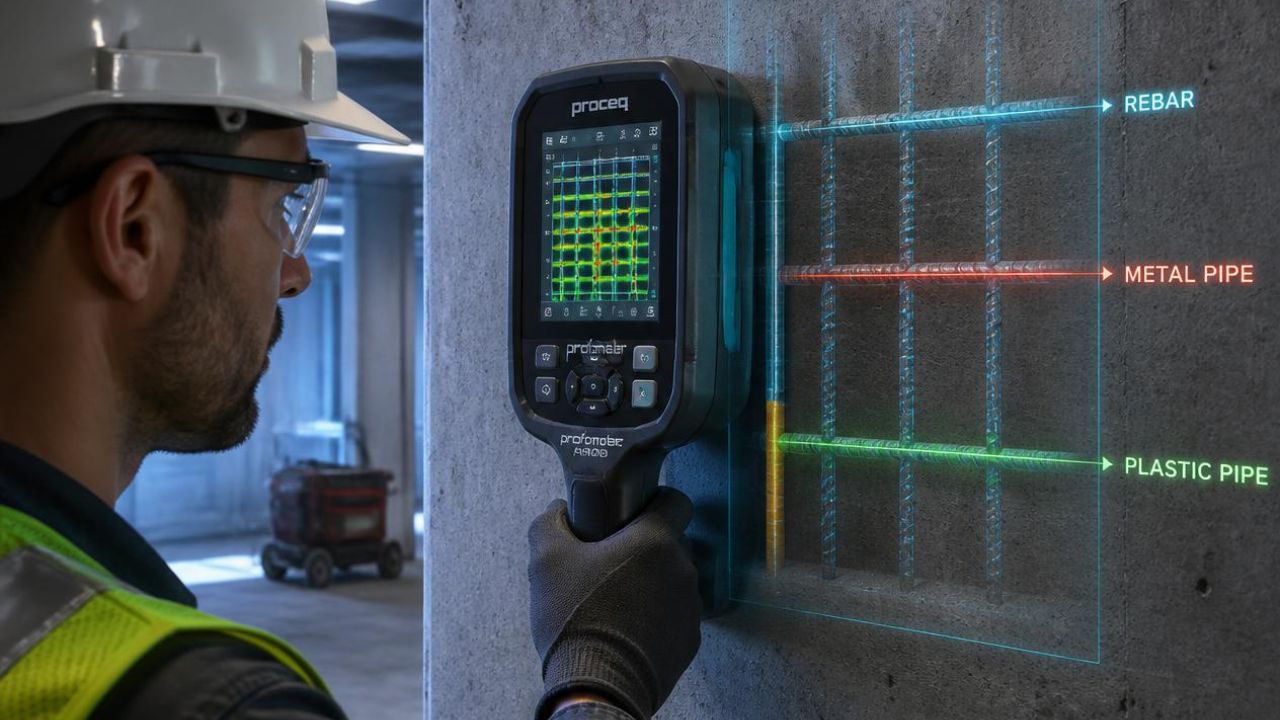
Concrete scanning for warehouses and industrial facilities identifies embedded hazards in slabs before construction crews begin cutting, coring, or drilling. This non-destructive testing method prevents accidents involving post-tension cables, protects workers from electrocution when striking live conduit, and eliminates costly project delays from unexpected subsurface discoveries. Industrial facilities contain dense networks of embedded reinforcement, electrical systems, and structural elements that require precise subsurface scanning before any penetration work begins.
Key Takeaways
- Ground Penetrating Radar detects post-tension cables, rebar, and embedded utilities before cutting or drilling operations begin
- Industrial construction activity grew to 276 million square feet under development in Q2 2026, driving increased demand for concrete scanning
- The 811 system locates only public utilities and does not cover 60% of underground infrastructure inside private facilities
- Post-tension cable strikes cost $2,875 to $14,220 per repair and require structural engineering assessments before work can resume
- 76% of utility strikes are preventable with proper subsurface verification protocols using GPR and electromagnetic detection
aBelow, you’ll find how Ground Penetrating Radar maps post-tension cables and buried utilities, why the 811 system leaves most private infrastructure unchecked, and what scanning costs and procedures look like for warehouse and industrial projects across California and Arizona.
Concrete Scanning for Warehouses Identifies Hazards Before Cutting or Drilling Begins
Concrete scanning uses Ground Penetrating Radar to map subsurface elements before cutting or drilling in industrial facilities. This technology prevents workers from striking post-tension cables carrying enough force to cause fatal injuries and structural collapse. Warehouse construction projects and facility renovations require concrete imaging and scanning to identify all embedded hazards before work begins.
Industrial environments contain complex subsurface infrastructure including high-voltage conduit, structural reinforcement, and pressurized utility lines. Manufacturing facilities, distribution centers, and cold storage warehouses require frequent equipment installations involving slab penetrations. Each drilling operation without prior scanning creates liability exposure and safety risks exceeding verification costs.
Ground Penetrating Radar Detects Subsurface Elements Through Radar Reflection
GPR sends radar pulses into concrete and reads reflections to map internal objects with millimeter-level accuracy. Technicians use calibrated 1.6 GHz or 2.0 GHz antennas designed for concrete scanning applications. Experienced operators can clear dozens of cutting and coring areas per day, allowing construction schedules to proceed without delay.
Radar waves penetrate concrete and reflect when encountering steel reinforcement, conduit, or voids. Different materials produce distinct reflection patterns that trained technicians interpret to create detailed subsurface maps. This process works effectively through concrete up to 18 inches thick in typical industrial applications.
Post-Tensioned Concrete Slabs Carry Serious Structural and Safety Risks
Post-tensioned concrete slabs use high-strength steel tendons stressed to 150,000 to 270,000 PSI after concrete cures, with each tendon carrying 24,000 to 33,000 pounds of continuous tension. Cutting a PT cable causes a violent snap and recoil that can kill workers within 30 feet of the strike point.
A severed PT cable causes immediate structural damage requiring engineering assessment before work proceeds, and the entire slab section’s structural integrity becomes compromised when primary tensioning elements are damaged.
Embedded Hazards Commonly Found in Warehouse and Industrial Floors
Electrocution risk from striking live conduit represents an immediate life-safety threat in industrial facilities. Water damage results from hitting plumbing waste lines embedded in or below slabs, and cutting primary structural rebar weakens the slab and requires immediate engineering assessment.
Below-slab hazards include gas lines, water services, fire suppression mains, and telecommunications conduits installed during previous tenant cycles. Multi-tenant industrial buildings often contain shared infrastructure that new occupants may not control or document.
Concrete Scanning for Warehouses Sees Rising Demand as Industrial Construction Grows
Industrial construction activity creates continuous demand for subsurface verification as facilities undergo expansion and tenant improvement work, and tightening vacancy is driving renovation activity as tenants compete for quality space.
Every new warehouse, distribution center, and manufacturing facility requires concrete scanning during initial construction and later tenant fit-out phases.
Current Trends in U.S. Industrial Construction and Leasing Drive Scanning Demand
The industrial vacancy rate reached 6.5% in Q2 2026, marking the first quarterly decline since Q2 2022. H1 2026 industrial leasing totaled 547.9 million square feet, up 18% year-over-year, and Q2 2026 net absorption reached 99.1 million square feet, nearly double Q1.
Large-format leases exceeding 700,000 square feet in H1 2026 surged 125% year-over-year, and these large-scale facilities require extensive concrete scanning during construction and equipment installation.
Tenant Improvements and Facility Expansions Increase Scanning Needs
Tenant improvement projects are interior buildouts for new or renewing commercial tenants that require slab penetrations. More than 265 million square feet of commercial real estate faced lease expirations in 2025, and each renewal or buildout adds to scanning demand.
U.S. data center construction starts reached $14.9 billion in 2023 and $77.7 billion in 2025, nearly four times the prior pace, and each site contains dense subsurface infrastructure that needs ground penetrating radar verification before crews penetrate any slab.
Financial Implications of Concrete and Utility Strikes Add Up Quickly
The average cost of a single utility strike reaches $56,000 when combining repairs, downtime, fines, claims, and legal expenses. The indirect-to-direct cost ratio for utility strikes stands at 29:1 based on documented case studies. A strike with $4,000 in direct damage generates approximately $120,000 in total costs.
Excavation-related utility damage creates roughly $30 billion in annual societal costs nationwide. Data centers with uptime commitments of 99.99% or higher treat any disruption as financially catastrophic, since a single hour of downtime averages $540,000 in losses.
Traditional Utility Locating Systems Like 811 Have Clear Limitations
The 811 system serves a critical public safety function but does not address the majority of subsurface hazards in industrial facilities. Public utility locating covers only infrastructure up to the meter, service connection, or property line. All internal facility utilities, embedded conduit, and structural elements fall outside 811’s scope and require private utility locators to identify accurately.
Industrial property owners cannot rely solely on 811, since most hazards exist beyond public utility service points. Contractors who assume 811 provides complete information expose projects to preventable strikes, injuries, and liability claims.
811 Does Not Cover Private Infrastructure in Industrial Facilities
The 811 system is a public call-before-you-dig service for locating public utility lines serving multiple properties, and its coverage ends regardless of what infrastructure exists beyond that point.
Private infrastructure represents more than 60% of all underground utilities in industrial and commercial properties, so facility owners must engage private locating services to map the subsurface environment where construction crews will work.
| Coverage Area | 811 Public Locate | Util-Locate Scanning |
| Utilities up to the meter or property line | Covered | Covered |
| Interior facility distribution lines | Not covered | Covered |
| Post-tension cables and rebar in slabs | Not covered | Covered |
| Abandoned or undocumented lines | Not covered | Covered |
| CAD and GPS engineering-grade documentation | Not provided | Provided |
Private Utility Locating Complements Public Utility Locates
Private utility lines represent more than 60% of all underground infrastructure but receive no coverage from 811. Property owners across California and Arizona rely on private utility locating services to close this gap, since 811 provides surface paint marks and flags but not the CAD drawings or GPS coordinates engineering teams need.
ASCE 38 Quality Level documentation represents the engineering-grade subsurface utility mapping standard that construction projects require for design coordination and liability protection.
Undocumented or Abandoned Subsurface Utilities Create Additional Risks
The 811 system does not locate abandoned or undocumented infrastructure that remains energized, pressurized, or structurally significant. Previous tenants may have installed undocumented electrical subfeeds, data lines, and specialized process piping, and building owners often lack accurate as-built records for facilities that have changed hands over 20-plus years.
Concrete Scanning Integrates Into Warehouse and Industrial Renovation Projects
Concrete scanning must be performed before cutting, coring, or drilling begins on any warehouse or industrial renovation project. Typical retail buildout timelines run 8 to 16 weeks from permit to certificate of occupancy, making front-end scanning critical for schedule protection.
Post-tension cables can shift during installation by 6 to 18 inches from their specified position, making original construction drawings unreliable on their own.
Concrete Scanning Is Recommended Before Tenant Improvement Work Begins
GPR scanning must occur before cutting, coring, or drilling begins to identify post-tension cables and embedded utilities accurately. Post-tension cables shift during installation and may sit several inches from their specified location on construction drawings. Professional GPR services prevent these incidents by verifying actual subsurface conditions rather than assuming drawings reflect reality.
Scanning Prevents Change Orders and Project Delays
Change orders account for 8% to 14% of project contract value industry-wide, and distressed projects with major subsurface issues can see that figure reach 25%. Rework and delays from inadequate planning cost the U.S. construction sector $177 billion annually, and concrete scanning eliminates the most common source of these discovery change orders by identifying hazards before crews mobilize.
Typical Scanning Procedures and Deliverables for Industrial Projects
Experienced technicians can clear dozens of cutting and coring areas per day using calibrated ground penetrating radar equipment. ASCE 38 Quality Level deliverables give crews marked floor plans, CAD drawings, and detailed reports documenting every detected element, along with clear guidance on what to do before concrete drilling begins.
Scanning procedures begin with site reconnaissance to identify access constraints and establish scanning grids. Technicians mark detected hazards directly on the concrete surface using color-coded paint, and final deliverables include photographic documentation, GPS coordinates, and written reports suitable for contractor coordination and regulatory compliance.
Ignoring Concrete Scanning Precautions Carries Significant Costs and Consequences
Repair costs for a struck post-tension cable vary by region, cable count, and access complexity. PT slab repairs also carry 30% to 60% cost premiums over equivalent non-PT concrete repair work, and the figures below exclude jobsite shutdown expenses, engineering assessments, and schedule delay impacts.
Cost Range for Post-Tension Cable Repairs and Associated Delays
| Repair Scenario | Typical Cost Range |
| Single monostrand repair (Texas residential slab) | $1,800 – $4,500 |
| Standard industrial PT cable repair | $2,875 – $11,850 |
| New York market PT cable repair | $3,450 – $14,220 |
| Full PT foundation repair (multiple cables) | $5,000 – $15,000+ |
| OSHA investigation following a cable strike | $15,000 – $150,000+ |
Utility Strikes Escalate Into Large Financial and Safety Liabilities
Construction jobsites shut down for days or weeks following PT cable strikes while structural engineers assess slab integrity, and structural engineering assessment becomes mandatory after any PT cable strike.
The average construction dispute value reached $60.1 million in 2024, up 40% from previous years. Average dispute resolution time extends 12.5 months from initial claim to final settlement. Understanding contractor liability and utility damage protocols helps project teams implement proper precautions.
Industry Data Reveals the Frequency and Impact of Utility Strikes
The Common Ground Alliance 2025 DIRT analysis reviewed 221,717 unique damage reports, with industry estimates placing annual utility strikes between 400,000 and 800,000. Failure to request a locate by calling 811 accounts for 24.54% of all utility damages, and 76% of strikes are preventable with proper precautions.
Concrete Scanning Services Strengthen Safety and Liability Management
Concrete scanning provides documented evidence of due diligence, protecting contractors from liability when subsurface conditions differ from provided drawings.
California and federal law require contractors to call 811 before all excavation projects. Contractors bore responsibility for 83% of natural gas damages in 2023, and telecommunications damage incidents that year showed contractors at fault in 92% of reported cases.
Scanning Reports Support Contractor Due Diligence and Compliance
Industry data shows that documented concrete scanning reports help general contractors limit unforeseen change orders and repair costs on congested industrial slabs. Project superintendents on large-scale builds consistently report that professional scanning clears safe drilling zones even in areas with dense embedded infrastructure.
Professional scanning reports give contractors verifiable documentation that reasonable care was exercised before invasive work began, supporting compliance with both state and federal excavation law.
Accuracy Standards and Experience Define Reliable Scanning Services
Util-Locate maintains a 97% accuracy rate across more than 11,000 locates performed annually, backed by more than two decades of field experience since 2001. This track record demonstrates that ground penetrating radar technology delivers reliable results when operated by trained, certified technicians who follow detailed quality control protocols, including equipment calibration and systematic documentation.
Concrete Scanning Aligns With California and Arizona Regulatory Requirements
California Government Code 4216 establishes fines ranging from $500 to $10,000 per incident for excavation violations, including failure to properly verify subsurface conditions. These penalties apply directly to contractors and property owners, and Arizona maintains a similar regulatory framework requiring contractors to exercise reasonable care.
Both states recognize that 811 public utility locating provides only partial subsurface information and does not eliminate contractor liability for private infrastructure strikes. Documented scanning reports satisfy regulatory requirements by proving that contractors investigated subsurface conditions before commencing work, supporting broader damage prevention efforts across both states.
Selecting and Implementing Concrete Scanning Solutions Requires Careful Evaluation
Professional scanning providers should demonstrate accuracy rates verified across real project histories, as outlined above. Qualified providers also employ technicians trained on multiple GPR systems and maintain current equipment calibration, so scanning stays aligned with industrial project schedules.
Industrial Buyers Should Evaluate Scanning Providers on Accuracy and Documentation
Documentation capabilities should include ASCE 38 Quality Level deliverables providing engineering-grade subsurface maps and GPS coordinates. Experience in utility locating that saves money on project timelines shows a provider understands construction economics.
Provider selection should prioritize companies offering comprehensive services, including GPR concrete scanning, electromagnetic utility locating, and vacuum excavation. Multi-service providers eliminate coordination complexity by delivering complete subsurface verification through a single point of contact.
Scan Scope, Pricing, and Scheduling Efficiency Depend on Several Factors
Experienced project managers can clear dozens of cutting and coring areas per day, allowing construction schedules to proceed without delay. Scan scope depends on penetration locations, slab thickness, and congestion level, while pricing reflects mobilization costs, scanning area square footage, documentation requirements, and urgency.
Scheduling efficiency improves when scanning occurs during preconstruction phases before trades mobilize. Rush scanning requests cost more because they require priority scheduling and expedited report production.
Integrating Scanning Services Streamlines Construction and Renovation Workflows
Typical retail buildout timelines run 8 to 16 weeks from permit to certificate of occupancy, making early scanning critical. Restaurant buildout projects require 12 to 22 weeks of construction following 4 to 12 weeks of permitting, and change orders consume 8% to 14% of project contract value industry-wide.
Integrated scanning workflows incorporate GPR verification as a standard preconstruction activity. Early scanning lets designers route utilities through verified clear zones instead of discovering conflicts mid-construction, compressing overall project duration.
Concrete Scanning for Warehouses and Industrial Facilities: Strategic Risk Mitigation and Construction Efficiency
Subsurface utility mapping and concrete scanning protect construction projects from preventable accidents, costly repairs, and schedule disruptions, preventing strikes that cost an average of $56,000 per incident plus indirect losses exceeding 29 times direct damage costs. Since 76% of strikes remain preventable, integrating concrete scanning into standard workflows turns subsurface verification from a reactive cost center into a strategic risk management tool.
Schedule Concrete Scanning With Util-Locate Before You Cut, Core, or Drill
Util-Locate has protected warehouse and industrial construction crews across California and Arizona since 2001, completing more than 11,000 locates a year at a 97% accuracy rate. Put a certified GPR technician on your slab to map post-tension cables, conduit, and private utilities that 811 will never mark. Call 1-888-885-6228 or request a quote to schedule concrete scanning for your next project.
