Ground Penetrating Radar technology has become essential for high-rise construction projects throughout Los Angeles County. The dense underground infrastructure and strict seismic building codes create unique challenges requiring precise subsurface detection capabilities.
Advanced ground-penetrating radar high-rise scanning systems deliver real-time data on concrete integrity and hidden utilities. This non-destructive testing method protects structural safety while preventing catastrophic utility strikes during excavation and core drilling operations.
Key Takeaways
- GPR prevents utility strikes costing $25,000 to $100,000 per incident in urban high-rise projects
- High-frequency antennas detect post-tension cables and rebar with 97% accuracy in concrete scanning
- Los Angeles high-rise construction shows 65% GPR adoption driven by seismic safety requirements
- Equipment options range from $11,000 handheld scanners to $350,000 multi-frequency systems
- Contractors exceeding 50 projects annually achieve payback within 6 to 18 months
What Is Ground Penetrating Radar and How Does It Work in Construction?
Ground Penetrating Radar uses electromagnetic pulses to map subsurface conditions without invasive drilling or excavation. How ground penetrating radars work involves transmitting radio waves that reflect differently off various underground materials and objects.
The reflected signals create detailed images showing the exact locations of rebar, utilities, and voids. Operators analyze these radargrams to identify subsurface features before breaking ground on construction sites.
Key Components and Technology of GPR Systems
Ground Penetrating Radar is a specialized geophysical tool used for non-destructive testing across construction applications. Multi-frequency antennas with real-time 3D visualization enable operators to scan concrete slabs and soil simultaneously.
AI-assisted interpretation software transforms raw radar data into actionable visual maps showing subsurface conditions. These technological advances reduce human error in identifying critical infrastructure, such as post-tension cables and live conduits.
Differences Between High-Frequency and Low-Frequency Antennas
High-frequency antennas range from 1.0 to 2.6 GHz for concrete scanning applications requiring shallow penetration. These antennas detect rebar spacing, post-tension cables, and embedded conduits within 18 inches of surface depth.
Lower-frequency antennas range from 100 to 500 MHz for utility detection with up to 15 feet of ground penetration. Very low-frequency antennas range from 10 to 100 MHz for deep geological interpretation beneath building foundations.
Typical GPR Applications in Construction Projects
Concrete investigation focuses on detecting rebar, post-tension cables, conduits, and voids within concrete slabs before cutting. This application prevents costly structural damage during tenant improvements and renovation work in existing buildings.
Utility detection uses lower-frequency antennas to locate underground pipes, electrical cables, and telecommunications infrastructure prior to excavation. Concrete imaging and scanning methods support accurate mapping for high-rise construction documentation and regulatory compliance.
Why Is GPR Crucial for High-Rise Construction in Los Angeles?
High-rise GPR scanning for LA projects face exceptional risk due to dense underground utilities and seismic regulations. Damage to post-tension cables can cause catastrophic structural failure, affecting the entire building’s stability and occupant safety.
High liability associated with seismic structural integrity in dense urban environments drives mandatory scanning protocols. Los Angeles building safety regulations require comprehensive subsurface documentation before permits are issued for excavation or core drilling.
Role of GPR in Seismic Safety and Regulatory Compliance
Post-tension cable systems maintain structural integrity in earthquake-prone regions like Los Angeles County and surrounding areas. Accidental severing during renovation work releases tremendous stored tension, causing immediate concrete failure and potential building collapse.
Building inspectors increasingly require GPR documentation proving subsurface conditions were verified before construction begins. This regulatory shift protects public safety while establishing clear liability boundaries for contractors and property owners.
Challenges of Underground Utility Density in Urban Los Angeles
Over 192,000 utility damages reported in a single year demonstrate the scale of subsurface hazards nationwide. Downtown Los Angeles high-rise sites contain layered infrastructure, including water mains, gas lines, fiber optic cables, and electrical conduits.
Utility locating skyscrapers in Los Angeles requires specialized equipment capable of penetrating congested subsurface conditions with precision. Managing construction excavation risks becomes critical when multiple utility networks overlap within confined urban footprints.
Risk Mitigation and Safety Benefits Specific to High-Rise Projects
Utility strikes cost an average of $25,000 to $100,000 per incident in direct repair costs, fines, and project delays. Damage to live conduits can cause fatal electrocution when construction crews encounter unexpected electrical infrastructure during excavation.
Effective utility detection yields an ROI of $21 for every dollar spent on prevention and scanning services. Blind excavation poses a pervasive risk in construction projects where aging infrastructure records contain incomplete or inaccurate documentation.
Who Uses GPR in the Los Angeles Construction Market and What Drives Adoption?
Professionals aged 45-54 show 72% adoption rate, reflecting recognition of risk mitigation value among experienced project managers. Professionals aged 35-44 show 68% adoption rate as mid-career superintendents implement proactive safety protocols on jobsites.
Urban centers have 76% adoption rate compared to 62% in suburban areas and 38% in rural regions. This geographic variation reflects infrastructure density, property values, and regulatory enforcement levels affecting construction practices statewide.
Adoption Rates by Demographic and Geographic Factors
West Coast leads national adoption at 78%, driven by seismic building codes and high-value urban development projects. Los Angeles structural renovation projects show 72% GPR utilization, where existing buildings require extensive concrete investigation before modifications.
Los Angeles demolition projects show 68% adoption rate for pre-construction hazard assessment and structural integrity evaluation. Los Angeles high-rise construction shows 65% adoption rate focused on post-tension cable location and subsurface utility mapping.
Consumer Priorities in Selecting GPR Technology
Construction professionals prioritize accuracy, safety features, and cost-effectiveness when evaluating GPR equipment and service providers. Real-time data visualization ranks highest among decision factors, allowing immediate interpretation without laboratory analysis delays.
Five reasons to use GPR for construction projects include preventing utility strikes, documenting subsurface conditions, and maintaining project timelines through efficient scanning protocols.
Market Segments With the Highest Utilization in Los Angeles
Concrete inspection holds 32% market share, driven by structural renovation demands in aging commercial building stock. Utility detection accounts for 28% of market applications, particularly critical for excavation planning in congested urban sites.
Demolition and pre-construction assessment represents 22% of market activity requiring multi-frequency systems for comprehensive hazard identification. Environmental and geophysical surveys comprise 12%, serving specialized consultants performing deep soil analysis and contamination mapping.
How Is GPR Applied Across Different Construction Categories?
Concrete inspection and structural assessment utilize high-frequency antennas to map rebar placement before cutting or drilling. This application prevents accidental damage to load-bearing reinforcement that could compromise structural integrity in occupied buildings.
Structural integrity evaluation before demolition identifies post-tension cables, conduits, and voids requiring special handling procedures. Factors affecting GPR accuracy include concrete moisture content, reinforcement density, and subsurface material composition at scan locations.
Concrete Inspection and Structural Assessment Techniques
Operators conduct systematic grid scans across concrete surfaces, marking detected objects with chalk or paint for reference. Two-dimensional cross-sections reveal the depth and orientation of embedded features, guiding safe cutting and coring operations.
Three-dimensional visualization software compiles multiple scan passes into comprehensive subsurface models for engineering analysis. These detailed maps support structural calculations and renovation planning for high-rise tenant improvement projects throughout Los Angeles.
Utility Detection and Underground Mapping Methods
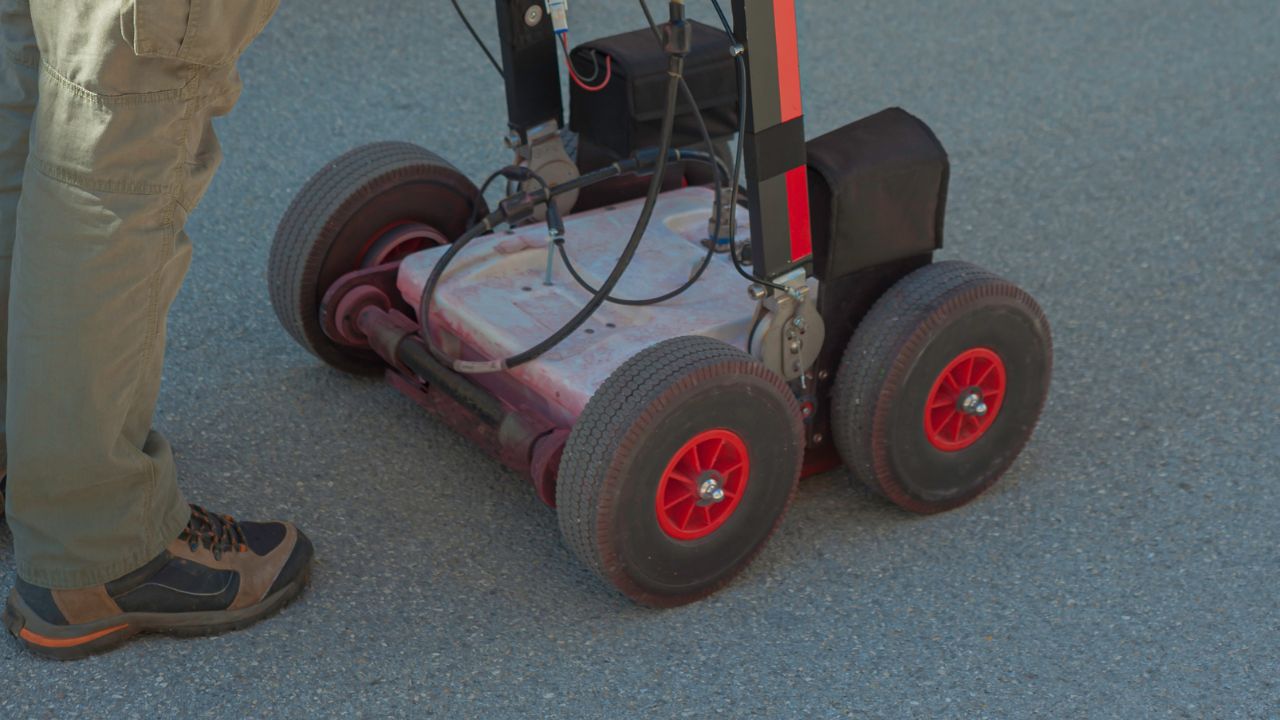
Cart-based systems with lower-frequency antennas detect buried utilities up to 15 feet below ground surface. Why use GPR for utility locating focuses on preventing service interruptions that cascade across interconnected infrastructure networks in urban environments.
Operators mark detected utility paths on pavement or soil surface, creating visual reference maps for excavation crews. Digital deliverables include CAD drawings showing utility positions relative to proposed construction activities and building footprints.
Pre-Construction and Demolition Hazard Assessments
Multi-frequency scanning identifies both shallow concrete features and deep geological conditions affecting foundation design and demolition sequencing. Hazardous materials embedded in older structures become visible through density variations detected by radar signal analysis.
Pre-demolition surveys document structural conditions, protecting contractors from liability when unexpected conditions emerge during building dismantlement. Los Angeles ground penetrating radar services provide comprehensive site assessment supporting permit applications and insurance requirements.
What Equipment Options Are Available for High-Rise Construction GPR Needs?
Handheld concrete scanners include GSSI StructureScan and Proceq models optimized for interior structural assessment applications. These portable units weigh under 10 pounds, enabling single-operator deployment across vertical surfaces and overhead ceiling scans.
Market leaders include Geophysical Survey Systems, Inc. (GSSI) and Hexagon AB (Leica), offering proprietary software platforms. Cart-based utility systems provide a stable platform for outdoor scanning across large site areas requiring comprehensive utility mapping.
Handheld Concrete Scanners Versus Cart-Based Systems
Handheld scanners excel in confined spaces and multi-story buildings where equipment portability determines operational feasibility. These units deliver real-time imaging on integrated displays, allowing immediate interpretation without external computer connections.
Cart-based systems cover larger ground areas efficiently through continuous scanning along predetermined survey lines and grid patterns. Wheels and adjustable handles reduce operator fatigue during extended scanning sessions across parking lots and excavation zones.
Vehicle-Mounted and Premium Multi-Frequency Solutions
Vehicle-mounted systems attach to trucks or specialty vehicles, scanning roadways and large infrastructure corridors at highway speeds. These installations support pavement analysis, subsurface void detection, and utility mapping across miles of linear infrastructure.
Premium multi-frequency systems combine multiple antenna arrays capturing shallow and deep subsurface data in a single scanning pass. Simultaneous frequency operation reduces project time while delivering comprehensive subsurface intelligence for complex high-rise construction planning.
Pricing, Rental, and Service Cost Comparisons
Handheld concrete scanners cost $11,000 to $17,000 for purchase versus $1,000 to $2,500 monthly rental. Cart-based utility systems range from $14,000 to $100,000 for purchase versus $1,000 to $4,000 monthly rental.
Vehicle-mounted systems require a $50,000 to $150,000 purchase investment versus $5,000 plus monthly rental for specialized applications. Premium multi-frequency systems span $20,000 to $350,000 purchase range versus $5,000 plus monthly rental for advanced projects.
When Should Contractors Buy, Rent, or Hire GPR Services for Optimal ROI?
Purchase equipment for high frequency exceeding 50 projects per year, where internal scanning capabilities justify capital investment. Rent equipment for moderate frequency between 5 and 20 projects per year, balancing cost against operational flexibility.
Hire specialized service for low frequency below 5 projects per year, shifting liability and training requirements to external providers. Payback period typically spans 6 to 18 months for active contractors versus immediate per-project costs for rental or hired services.
Decision Factors Based on Project Frequency and Capital Availability
High-volume contractors achieving rapid payback justify equipment purchases supporting competitive bidding on GPR-dependent projects statewide. Moderate-volume firms preserve capital through rental arrangements, providing access to the latest technology without depreciation risk or storage costs.
Low-volume contractors minimize overhead by hiring insured specialists handling complex data interpretation and regulatory documentation requirements. Evaluate project frequency and internal capabilities before deciding to purchase, rent, or hire for specific organizational circumstances.
Training Requirements and Liability Considerations
A steep learning curve for data interpretation requires extensive training in distinguishing between subsurface materials and scanning artifacts. Extensive training and certification requirements for operators include classroom instruction and supervised field experience before independent deployment.
Complex data interpretation differentiates between PVC pipe, rebar grid, and subsurface void based on signal characteristics. Complex radargrams require skilled analysis, preventing misidentification that could lead to costly utility strikes or structural damage.
Common Purchase Objections and Mitigation Strategies
High initial capital cost between $11,000 and $100,000 plus, creates a financial barrier for smaller construction firms. Demonstrating rapid payback through avoided utility strikes and insurance premium reductions justifies investment for active contractors.
Equipment depreciation and technology obsolescence concern firms hesitant to commit capital toward rapidly evolving scanning platforms. Manufacturers address concerns through trade-in programs, software updates, and flexible financing arrangements supporting equipment acquisition decisions.
How Can Los Angeles Construction Firms Integrate GPR Within Project Workflows?
Integrate GPR scanning into standard pre-construction protocols, ensuring subsurface intelligence informs excavation planning and permit applications. Treat GPR scanning as a non-negotiable safety requirement rather than an optional assessment, minimizing liability exposure and regulatory violations.
Schedule scanning during the mobilization phase, allowing sufficient time for data analysis and construction plan adjustments. Documentation from scanning activities supports contractor compliance with Los Angeles building safety regulations and insurance policy requirements.
Best Practices for Pre-Construction Scanning Protocols
Conduct comprehensive site surveys before mobilizing heavy equipment, identifying all subsurface hazards and structural constraints affecting construction sequencing. Mark detected utilities and concrete features using standardized color codes, ensuring field crews understand subsurface conditions.
Maintain digital archives of all scan data supporting future renovation work and providing liability protection against claims. Update facility documentation reflecting as-built conditions discovered during scanning activities, ensuring accurate records for building management teams.
Certification and Training Recommendations for Internal Teams
Certify 2 to 3 internal operators for handheld concrete scanners supporting efficient project execution without external dependencies. Training programs typically require 40 hours of classroom instruction plus supervised field scanning under experienced technician guidance.
Recertification every two years maintains operator proficiency, addressing technology updates and regulatory changes affecting scanning protocols. Investment in operator development reduces subcontractor costs while improving project control and schedule reliability across multiple jobsites.
Partnering With Specialized Service Providers in High-Risk Projects
High-rise projects involving post-tension cables warrant hiring specialized providers carrying comprehensive liability insurance and professional certifications. These partnerships transfer risk while providing access to advanced equipment and experienced technicians familiar with complex structural systems.
Emergency response capabilities become critical when unexpected subsurface conditions halt construction activities, requiring immediate expert assessment. Established service relationships enable rapid mobilization, minimizing costly project delays when scanning requirements emerge during active construction phases.
Strategic Insights on GPR Adoption for High-Rise Construction Projects in Los Angeles
The global GPR market, valued at $568.5 million in 2024, reflects widespread recognition of non-destructive testing benefits. Projected to reach $915 million by 2030, driven by infrastructure investment and mandatory safety compliance programs.
Industry CAGR of 7.87% over the next five years indicates sustained demand across construction and engineering sectors. The concrete investigation segment has an anticipated CAGR of 9.2%, positioning this application category as the fastest-growing market segment.
The integration of GPR technology transforms construction safety standards across Los Angeles high-rise projects and urban development sites. Contractors adopting systematic scanning protocols demonstrate commitment to crew protection, regulatory compliance, and project success through informed decision-making.
Schedule Your High-Rise GPR Scan with Util-Locate
Los Angeles high-rise projects leave no room for guesswork below the surface. Util-Locate brings ground penetrating radar scanning and 97% locate accuracy to your jobsite, mapping post-tension cables, rebar, conduits, and buried utilities before you cut, core, or excavate. Our certified technicians have protected complex California construction sites since 2001, delivering real-time, on-site data your team can act on the same day. Schedule your GPR scan online or contact us to book a pre-construction survey that keeps your crew, your timeline, and your structure safe.