Los Angeles contractors face significant risks when excavating without subsurface intelligence about embedded utilities and structural elements. GPR before excavation in Los Angeles has become the industry standard for identifying hidden hazards before cutting or drilling begins. The technology uses radio waves to create detailed images of what lies beneath concrete slabs and soil layers.
Construction accidents from striking utilities or severing post-tension cables create immediate safety threats and financial liabilities. Professional ground-penetrating radar contractors deliver real-time data, preventing service interruptions. This proactive approach aligns with utility locating safety in Los Angeles requirements and protects crews from potentially fatal incidents.
Key Takeaways
- GPR technology detects both metallic and non-metallic objects up to 24 inches deep in concrete
- Utility strikes cause $11.5 billion in construction damages annually across the United States
- Los Angeles building permits grew 14.3% year-over-year in Q2 2025, increasing scanning demand
- Professional GPR scanning costs $500-$1,500 for standard projects, preventing $10,000-$30,000 in repairs
- Millennial contractors now represent one in five, spending over $5,000 annually on construction improvements
What Is Ground Penetrating Radar (GPR) and How Does It Work?
Ground Penetrating Radar transmits high-frequency radio waves into concrete or soil and analyzes reflected signals. The technology identifies both metallic objects like rebar and non-metallic materials, including PVC pipes and voids. How ground penetrating radars work involves measuring the time delay between transmission and signal return to calculate depth and location.
GPR systems represent 45% of the pre-construction scanning technology market due to superior penetration and versatility. Equipment typically penetrates 18 to 24 inches in cured concrete, compared to electromagnetic scanning, limited to eight inches. This deeper reach makes GPR the preferred choice for complex excavation projects requiring comprehensive subsurface mapping.
Key Features and Technology Types in Pre-Construction Scanning
Pre-excavation scanning techniques utilize multiple technologies addressing different detection requirements. GPR detects both metallic reinforcement and non-metallic utilities, while electromagnetic scanning only identifies ferrous materials within 120 to 200 millimeters. X-ray scanning requires site evacuation due to radiation hazards, whereas GPR allows workers to remain nearby during data collection.
Modern GPR systems deliver faster results, completing scans in minutes rather than hours. Equipment manufacturers have developed handheld units like the GSSI StructureScan Mini XT for accessibility in confined spaces. Fresh concrete poses challenges due to high moisture content, affecting signal clarity.
Advantages of GPR Compared to Alternative Scanning Methods
GPR provides comprehensive detection without exposing workers to radiation or requiring evacuation. The technology penetrates nearly twice as deeply as electromagnetic alternatives, revealing objects up to 24 inches below concrete surfaces. Why contractors use GPR for utility locating because of its ability to identify diverse materials, including post-tension cables and plastic conduits.
Data collection speed distinguishes GPR from X-ray methods, demanding more setup time and regulatory compliance. Non-metallic object detection gives contractors visibility into PVC pipes, voids, and delamination that electromagnetic scanners cannot identify. Cost efficiency emerges from preventing damage rather than paying for emergency repairs and project extensions.
Why Is Pre-Excavation Scanning Critical in Los Angeles Construction?
Los Angeles construction regulations increasingly mandate subsurface scanning before invasive operations on concrete structures and near underground utilities. The region’s building permit growth of 14.3% year-over-year in Q2 2025 has intensified scrutiny on safety protocols. Professional scanning prevents accidents, contributing to the construction industry’s record of one in five fatal workplace injuries.
Residential construction expanding at 17.8% and commercial projects growing at 12.1% create more opportunities for utility conflicts. The $12.3 billion regional infrastructure budget funds projects where utility strikes can be prevented through proper pre-excavation investigation. Scanning technology addresses these risks by mapping embedded systems before equipment contacts critical infrastructure.
Safety Risks and Regulatory Requirements
Severing a post-tension cable releases explosive energy, posing lethal threats to workers near the cutting location. Construction accounts for one in five fatal workplace injuries, with many incidents involving unidentified subsurface hazards. Environmental contamination from silica dust released compounds safety concerns when improper cutting methods fragment concrete.
Immediate structural sagging follows post-tension cable damage, threatening building integrity and occupant safety. Los Angeles construction regulations require documentation of subsurface conditions before permits authorize invasive work. Construction injuries and accidents cause $11.5 billion in damages annually, with utility strikes representing a significant portion.
Cost Implications of Utility Strikes and Structural Damage
Repairing a single severed post-tension cable costs between $10,000 and $30,000, excluding project delays and engineering reassessments. Utility strikes trigger project shutdowns until damage assessment and repairs restore safe working conditions. Legal liabilities from improper cutting create additional financial exposure when negligence contributes to accidents.
GPRS prevented over $300,000 in repair costs at a Little Rock financial institution by identifying post-tension cables. The scan revealed embedded cables in all ten proposed coring locations, forcing the contractor to select alternative anchor points. Professional scanning services costing $1,000 to $5,000 per day deliver a substantial return on investment by avoiding six-figure emergency repairs.
Influence of Regional Construction Growth and Market Demands
Los Angeles has added 22,500 new construction jobs since January 2025, creating demand for specialized subsurface investigation services. Building permits in the region grew 14.3% year-over-year as residential and commercial development accelerated. The $12.3 billion regional infrastructure budget funds projects where accurate utility mapping prevents delays and cost overruns.
Residential construction growth at 17.8% outpaces commercial expansion at 12.1%, reflecting housing demand in urban and suburban areas. Los Angeles County represents 32% of California’s concrete scanning demand due to dense infrastructure and active development. This market concentration supports specialized providers offering Los Angeles ground penetrating radar services tailored to local construction requirements.
How Do Contractor Demographics Influence GPR Adoption?
Millennial contractors now account for one in five, spending more than $5,000 annually on construction and renovation projects. This generation demonstrates higher technology adoption rates and relies on data-driven planning methods. Digital natives prefer service providers offering online scheduling, real-time reporting, and CAD-ready deliverables.
Generation X represents 34% of consumer spending in construction, maintaining a steady market share. Baby Boomers still control 33.7% of spending but have declined from 43.7% in 2020 as younger generations assume decision-making authority. These demographic shifts influence how contractors research providers and evaluate scanning technologies.
Generational Preferences in Technology Use and Planning
Millennials use social media and YouTube for project planning at 39%, compared to 23% for Generation X. Baby Boomers rely on social platforms only 9% of the time, preferring word-of-mouth recommendations and in-store consultations. This generational divide affects how scanning service providers market capabilities.
Younger contractors prioritize companies with strong online presence, verified reviews, and educational content explaining technology benefits. Generation X balances digital research with direct conversations, seeking providers demonstrating both technical expertise and clear communication. Baby Boomer contractors value long-term relationships and proven track records over digital marketing.
Regional Consumer Profiles and Project Types in Los Angeles
Los Angeles County generates 32% of California’s scanning demand, with 58% originating from urban core projects in downtown areas. Suburban developments contribute 35% of regional demand as residential construction expands. Mixed urban-rural areas account for 7% of requests, typically involving agricultural land conversion.
Urban core projects involve high-rise construction, parking structure modifications, and tenant improvement work in occupied commercial buildings. Suburban demand centers on residential additions, pool installations, and utility service upgrades requiring excavation near existing foundations. Baby Boomers represent 33.7% of spending, down from 43.7% in 2020.
Priority Criteria When Selecting Scanning Services
Accuracy ranks as the top decision criterion at 98% importance, with contractors requiring near-perfect detection rates. Cost considerations follow at 92% importance as project budgets dictate spending limits. Safety guarantees achieve 88% importance rating because contractors need assurance against utility strikes.
Turnaround time matters to 85% of decision-makers who must maintain construction schedules and coordinate multiple trades. Technology quality scores 82% importance as contractors seek providers using modern equipment capable of delivering detailed 3D mapping. Certification requirements reach 80% importance, with SIM credentials validating operator expertise.
What Technologies Complement or Compete With GPR in Excavation Scanning?
Multiple scanning technologies serve different detection requirements based on material types, depth requirements, and budget constraints. GPR dominates with 45% market share, followed by electromagnetic scanning at 25% and ultrasonic methods at 20%. Each technology offers distinct advantages for specific applications.
X-ray scanning maintains 7% market share despite declining use due to radiation safety concerns and slower data collection. The technology produces clear images requiring minimal interpretation but demands access to both sides of concrete slabs. GPR versus concrete X-ray for utility location comparisons highlight the practical advantages of radar-based systems.
Electromagnetic and Ultrasonic Methods Overview
Electromagnetic scanning uses electromagnetic fields to locate steel reinforcement and estimate rebar diameter and cover depth. The technology holds 25% market share for applications focused exclusively on metallic object detection within shallow depths. Electromagnetic methods cannot identify non-metallic materials like PVC pipes or voids.
Ultrasonic pulse echo represents 20% of the market share for structural integrity testing and thickness measurement. The technology uses sound waves to detect internal flaws, honeycombing, and material inconsistencies. Point-by-point testing methodology makes ultrasonic scanning time-intensive for large areas compared to GPR’s continuous data collection.
Role and Limitations of X-Ray Scanning
X-ray scanning employs radioactive isotopes to create detailed photographs of concrete interior conditions and embedded utility locations. The technology accounts for only 7% of market share due to radiation hazards requiring site evacuation during operation. Access requirements to both sides of concrete slabs limit X-ray applications.
Radiation safety protocols add complexity and cost compared to non-invasive alternatives like GPR technology. The method produces clear, unambiguous images requiring less interpretation expertise than radar-based systems. Ultrasonic testing shares the time-intensive characteristic due to methodical analysis across large areas.
Pricing Differences Among Scanning Technologies
Standard GPR services cost $500 to $1,500 for typical half-day projects, while premium multi-technology investigations range from $1,500 to $5,000. Hourly rates average $250 to $300 with minimum fees of $250 to $500. Daily rates span $1,000 to $5,000 depending on project complexity and reporting requirements.
Emergency same-day service commands premium pricing between $2,000 and $6,000 for urgent utility strike investigations. Budget scanning alternatives using basic metal detectors cost $250 to $500 but provide limited detection capabilities without depth accuracy. Comprehensive packages combining GPR, electromagnetic scanning, and 3D reporting typically reach $1,000 to $3,000.
How Do Contractors Choose the Best GPR Provider in Los Angeles?
Contractors evaluate GPR providers based on accuracy guarantees, equipment quality, and operator certification levels. GPRS maintains a 99.8% accuracy rate across over 500,000 completed jobs, setting industry standards. The company’s Green Box Guarantee promises obstruction-free coring areas when layouts receive advance approval and proper marking.
Professional providers demonstrate expertise through SIM certification, which validates subsurface investigation methodology training. Why general contractors need fast and accurate locating services is directly related to project schedule maintenance and budget protection. Response time capabilities distinguish premium providers offering same-day and next-day availability.
Key Decision Factors: Accuracy, Cost, and Safety Guarantees
Accuracy requirements dominate contractor selection criteria, with 98% of decision-makers prioritizing detection reliability. Cost considerations rank second at 92% importance, as scanning expenses must fit within project budgets. Safety guarantees achieve 88% importance rating because contractors need protection against utility strikes, causing injuries.
Professional scanning prevents damage costs ranging from $10,000 to $30,000 per incident when post-tension cables or major utilities are severed. Service providers offering damage guarantees and liability coverage give contractors confidence in proceeding with invasive work. Technology quality and operator certification combine to ensure accurate data interpretation.
Overview of Leading Local and National Service Providers
GPRS operates nationwide with the Green Box Guarantee stating that marked areas will remain free of obstructions during coring. The company requires SIM certification for project managers, ensuring consistent methodology across all service locations. Their 99.8% accuracy rate across 500,000 jobs demonstrates the value of standardized training.
Safe2Core operates across California, Arizona, and Florida, offering integrated services including concrete scanning, cutting, coring, and hydro excavation. Prime Test Engineering serves Los Angeles with GSSI StructureScan Mini XT equipment and delivers detailed 2D and 3D digital reports. Enhanced Scanning differentiates through rapid response times, often providing same-day or next-day service.
Service Tiers and Pricing Structures in the Market
Budget scanning services cost $250 to $500 for basic GPR work or metal detector alternatives with limited reporting. Standard GPR packages range from $500 to $1,500 for professional scanning with 2D reporting on typical half-day projects. Comprehensive GPR and 3D mapping services cost $1,000 to $3,000 when combining multiple technologies with BIM-compatible deliverables.
Premium multi-technology investigations reach $1,500 to $5,000 for large-scale projects requiring utility locating, concrete scanning, and CAD overlay integration. Emergency same-day service commands $2,000 to $6,000 pricing due to schedule disruption and expedited response requirements. Hourly rates typically range from $250 to $300, while daily rates span $1,000 to $5,000 based on scope.
What Are the Practical Steps in GPR Scanning Before Excavation?
Professional GPR scanning follows systematic procedures beginning with site assessment and equipment calibration. Technicians identify proposed cutting or coring locations and mark boundaries using spray paint or chalk. Utility mapping prevents construction delays by providing accurate subsurface intelligence before crews mobilize.
Ground conditions affect scanning parameters, with operators adjusting antenna frequency based on concrete age, moisture content, and penetration depth requirements. The scanning process creates digital records documenting embedded utilities, reinforcement patterns, and void spaces. Data interpretation requires expertise in reading radar signatures and distinguishing between different material types.
Equipment and Scanning Process in the Field
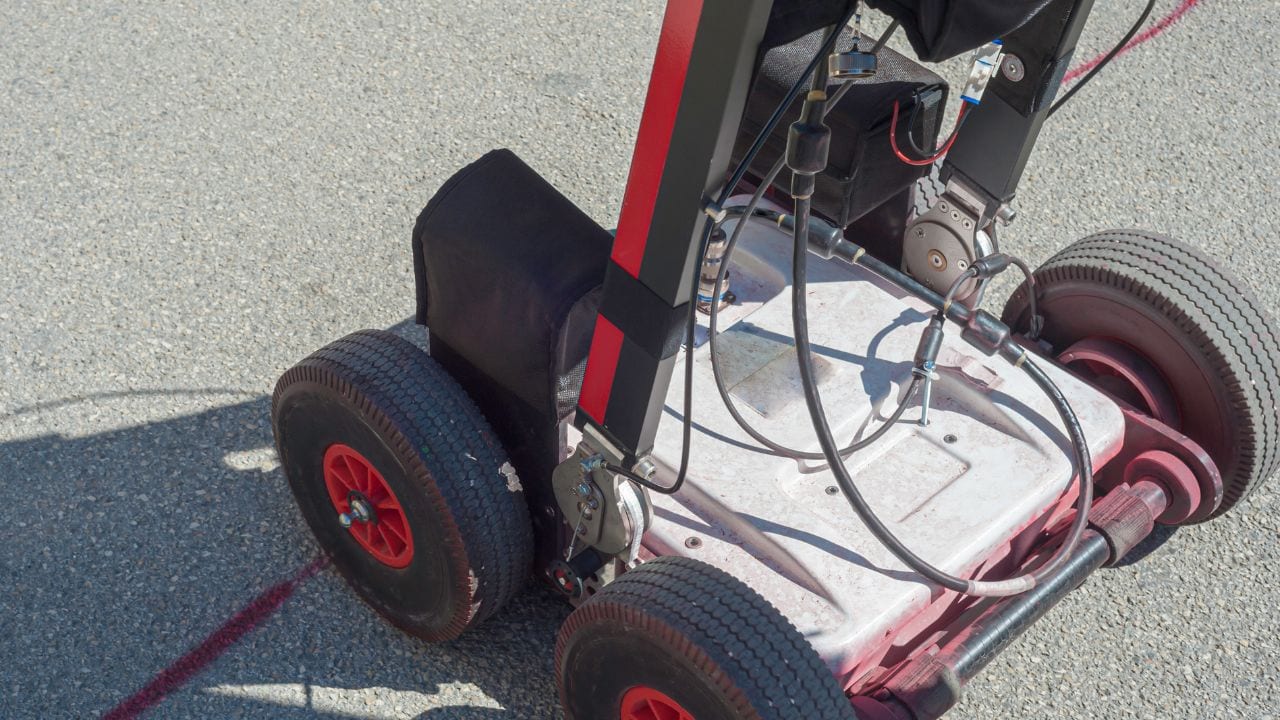
GPR scans reveal embedded utilities and reinforcements by transmitting radio waves and measuring reflection patterns from subsurface objects. Technicians push or pull antenna units across concrete surfaces in grid patterns, ensuring complete coverage. Modern equipment like the GSSI StructureScan Mini XT provides real-time imaging on handheld displays.
The scanning process typically requires 30 to 90 minutes, depending on area size and complexity. Technicians mark safe cutting and coring locations using spray paint after confirming the absence of utilities and critical structural elements. Field documentation includes photographs, measurements, and preliminary data notes supporting detailed reports.
Reporting, Data Interpretation, and Project Integration
Digital reports and CAD-ready data provide contractors with actionable intelligence for coordinating cutting, coring, and excavation operations safely. Professional scanning services deliver 2D cross-sections, 3D visualizations, and PDF documentation showing utility locations relative to proposed work areas. GPR requires expert interpretation because radar signatures vary based on material properties, depth, and environmental conditions.
CAD integration allows project teams to overlay scanning results onto architectural and engineering drawings for precise coordination. BIM-compatible deliverables enable digital collaboration among general contractors, subcontractors, and design professionals. Real-time data availability supports immediate decision-making when field conditions differ from as-built documentation.
Mitigating Risks Through Professional Scanning Practices
Contractors proceed with cutting or coring in marked safe zones after receiving scan results and location verification. Why utility potholing is essential for a successful construction project becomes clear when GPR data requires physical verification before invasive work begins. SIM certification refers to the Subsurface Investigation Methodology training that validates a project manager’s expertise.
Professional practices include maintaining exclusion zones around identified utilities and implementing secondary verification procedures. Documentation protocols ensure scan results remain accessible throughout the project duration for reference during unexpected field conditions. Quality assurance measures prevent miscommunication between scanning technicians and cutting crews.
How Does GPR Scanning Deliver Value Beyond Cost Savings?
GPR scanning prevents project shutdowns that occur when utility strikes halt construction until damage assessment and repairs restore operational conditions. Legal liabilities from improper cutting create financial exposure when contractors face claims for service disruptions. Professional scanning eliminates these risks by identifying hazards before equipment contacts critical infrastructure.
Insurance premiums often decrease for contractors demonstrating consistent use of pre-excavation scanning as part of standard safety protocols. Documentation from professional scanning services provides legal protection when disputes arise over damage responsibility. The value proposition extends beyond immediate cost savings to include reputation protection and long-term client relationships.
Preventing Project Delays and Legal Liabilities
Project shutdowns from utility strikes immediately halt construction until repair crews restore damaged systems and safety inspections confirm site readiness. Legal liabilities from improper cutting expose contractors to claims for property damage, business interruption, and personal injury. Professional scanning services cost $500 to $1,500 for standard projects, but prevent delays costing thousands daily.
Documentation from certified scanning technicians provides evidence of due diligence when regulatory agencies investigate construction accidents. Contractual obligations often require pre-excavation scanning as a condition of insurance coverage and project bonding. Scanning results become permanent project records supporting warranty claims and future renovation planning.
Enhancing Worker Safety and Environmental Compliance
Environmental contamination from silica dust release occurs when improper concrete cutting methods create airborne particles, affecting worker health and nearby properties. Construction accounts for one in five fatal workplace injuries, with many incidents involving unidentified subsurface hazards. Professional scanning eliminates surprise encounters with post-tension cables, high-voltage conduits, and pressurized gas lines.
Safety compliance documentation from scanning services satisfies OSHA requirements for hazard identification. Environmental regulations increasingly mandate dust control measures when cutting concrete or excavating near sensitive areas. Scanning technology identifies hazardous materials, including asbestos-containing pipes, requiring specialized handling.
Case Examples Demonstrating Financial and Safety Benefits
GPRS prevented over $300,000 in repair costs at a Little Rock financial institution by identifying post-tension cables before coring operations. The scan revealed embedded cables in all ten proposed anchor locations, forcing the contractor to select alternative attachment points. This case demonstrates how $1,000 spent on professional scanning delivers a 300-to-1 return on investment.
Similar incidents occur regularly across Los Angeles, where contractors working without scanning accidentally sever utilities or compromise structural integrity. Professional scanning services have prevented countless utility strikes that would cause service interruptions, emergency repairs, and legal disputes. The financial benefits compound when considering avoided project delays, insurance claims, and reputation damage.
The Role of GPR Scanning in Supporting Safe and Efficient Los Angeles Excavation Projects
GPR technology has become essential infrastructure for Los Angeles contractors managing excavation projects in urban environments with dense utility networks. The $12.3 billion regional infrastructure budget funds projects where scanning prevents costly delays and protects public safety. Professional scanning services deliver subsurface intelligence enabling informed decision-making before crews commit to invasive operations.
Market growth projections indicate continued expansion for GPR services as building codes increasingly mandate pre-excavation investigation. Technological advances, including 3D visualization and BIM integration, improve data accuracy and coordination. The scanning industry’s expansion from $723.63 million in 2024 to a projected $976.30 million by 2031 reflects growing recognition of technology’s value.
Los Angeles contractors benefit from specialized providers like Util-Locate, who understand regional construction requirements and deliver rapid response capabilities. Professional scanning services protect workers, prevent utility strikes, and maintain project schedules by identifying subsurface hazards before excavation begins. The combination of accurate detection, comprehensive reporting, and safety guarantees makes GPR scanning an essential component of responsible construction practices.
Schedule Your GPR Scan Before You Break Ground
Before your crew cuts or drills, get a clear picture of what’s beneath the surface. Util-Locate gives Los Angeles contractors accurate, real-time GPR data that locates rebar, post-tension cables, conduits, and buried utilities, so you can excavate with confidence and keep your project on schedule. With 97% locate accuracy and more than 24 years of experience across Southern California, we help you prevent costly strikes before they happen. Schedule your service online!
